AWS Series — What is Elastic Block Store?
EBS which is Elastic Block Storage Volumes. There are different types of EBS Volumes available and there are different use-cases where each type will be used. Let us understand little deep about this.
What is Elastic Block Store?
It is the storage volume that can be attached to your EC2 instance which is the virtual server. This is nothing but a virtual hard disk that you attach externally to your computer.
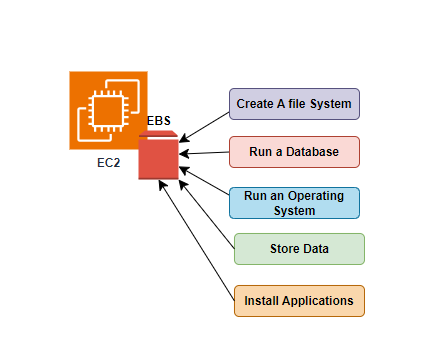
We would need to attach the storage to a place where the operating system is installed or where the applications or database is installed.
Let us say we are using Amazon Linux operating system, we would then install the EBS volume and install our applications and we also have database running on EBS. This can be flat files or SQL server or relational or non relational databases running on EBS. EBS allows us to install all kinds of things on it. It is basically just a virtual hard disk that is attached to your EC2 virtual instances.
It is just a virtual hard disk in the cloud that is attached to our EC2 Instance and it is highly available and scalable storage.
This is designed for our Mission Critical data
- Production Workloads — Designed for mission-critical workloads.
- Highly Available — Automatically replicated within a single Availability Zone to protect against hardware failures.
- Scalable — Dynamically increase capacity and change the volume type with no downtime or performance impact to your live systems.
Types of EBS Volume —
General purpose is basically to balance of price and performance.
General Purpose SSD (gp2)
- 3 IOPS per GiB, up to maximum of 16,000 IOPS per volume.
- gp2 volumes smaller than 1TB can burst up to 3000 IOPS
- Good for Boot volumes or development and test applications that are not latency sensitive.
General Purpose SSD (gp3)
- Predictable 3.000 IOPS baseline performance and 125 MiB/s regardless of volume size
- Ideal for applications that require high performance at a low cost, such as MySQL Cassandra, Virtual desktops, and Hadoop analytics
- Customers looks for high performance can scale up to 16,000 IOPS and 1,000 MiB/s for an additional fee.
- The top performance of gp3 is 4 times faster than max throughput of gp2 volumes.
Provisioned IOPS SSD(io1)
The “io” one is legacy one and this is chosen for high- performance option and the most expensive.
- Up to 64,000 IOPS per volume. 50 IOPS per GiB
- Use if you need more than 16,000 IOPS
- Designed for I/O-intensive applications, large databases, and latency-sensitive workloads.
Provisioned IOPS SSD (io2)
- Latest generation
- higher durability and more IOPS.
- io2 is same price as io1
- 500 IOPS per GiB. Up to 64,000 IOPS
- 99.999% durability instead of 99.9%
- I/O-intensive apps, large databases, and latency-sensitive workloads. Applications that need high levels of durability.
Throughput optimized HDD (st1)
Low-cost HDD volume
- Baseline throughput of 40 MB/s per TB.
- Ability to burst up to 250 MB/s per TB.
- Maximum throughput of 500 MB/s per volume
- Frequently accessed, throughput-intensive workloads.
- Big data, data warehouses, ETL and log processing
- A cost-effective way to store mountains of data
- Cannot be a boot volume.
Cold HDD (SC1)
- Lowest cost option
- Baseline throughput of 12 MB/s per TB
- Ability to burst up to 80 MB/s per TB.
- Maximum throughput of 250 MB/s per volume
- A good choice for colder data requiring frequent scans per day.
- Good for applications that need the lowest cost and performance is not a factor.
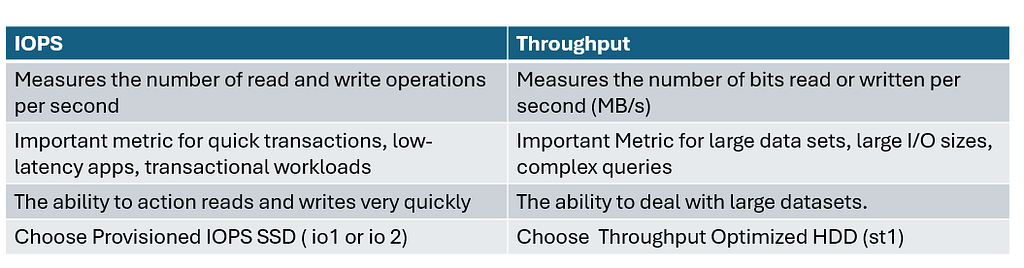
IOPS VS Throughput
Points to Remember —
SSD Volumes
gp2 —
- Suitable for boot disks and general applications.
- Up to 16,000 IOPS per volume
- Up to 99.9% durability
gp3 —
- Suitable for high performance applications
- Predictable 3,000 IOPS baseline performance nad 125 MiB/s regardless of volume size.
- Up to 99.9% durability
io1 —
- Suitable for OLTP and latency-sensitive applications
- 50 IOPS/GiB
- Up to 64,000 IOPS volume.
- High performance and most expensive
- Up to 99.9% durability
io2 —
- Suitable for OLTP latency- sensitive applications
- 500 IOPS/GiB
- Up to 64,000 IOPD per volume
- 99.999% durability
- Latest generation Provisioned IOPS volume
HDD Volumes
st1 —
- Suitable for big data, data warehouses and ETL
- Max throughput is 500 MB/s per volume.
- Cannot be a boot volume.
- Up to 99.9% durability
sc1 —
- Max throughput of 250 MB/s per volume.
- Less frequently accessed data
- Cannot be a boot volume
- Lowest cost
- Up to 99.9% durability