Over the past few years, serverless computing has become the go-to model for deploying scalable APIs, microservices, and bursty workloads. But serverless has a problem when it comes to Large Language Models (LLMs): cold start latency. Unlike typical functions that spin up in tens or hundreds of milliseconds, LLMs can take tens of seconds just to produce the first token due to model fetching, heavy libraries, and initialization sequences.
The paper HydraServe: Minimizing Cold Start Latency for Serverless LLM Serving in Public Clouds tackles this exact problem. It proposes a system designed for public cloud environments that dramatically shortens cold start times while still preserving the cost advantages of serverless LLM deployment.
Let’s unpack what the paper achieves, how it works, and why its techniques matter if you’re building cloud-scale AI services.
🧠 Why Cold Starts Are Especially Bad for LLMs
In traditional serverless computing — AWS Lambda, Azure Functions, or Cloud Run — cold starts occur when a function instance is provisioned to handle sporadic or bursty workloads. With typical functions, this non-trivial latency is usually due to:
- Runtime initialization
- Dependency loading
- Environment setup
But with LLMs, we add massive model weights, GPU initialization, and potentially multiple libraries such as CUDA or PyTorch. In real systems, a cold start can take more than 40 seconds before the first token is generated — orders of magnitude slower than typical serverless functions.
This defeats one of the main serverless promises: instant elasticity.
📦 HydraServe’s Core Idea: Overlap + Parallel Fetching
The key insight in the paper is that the main cold start bottleneck isn’t inference speed — it’s model fetching and setup.
Deeply effective cold start acceleration here relies on two advantages:
- Aggregated network bandwidth when fetching model parts across multiple servers
- Overlapping stages of initialization, such as fetching, loading, and runtime setup
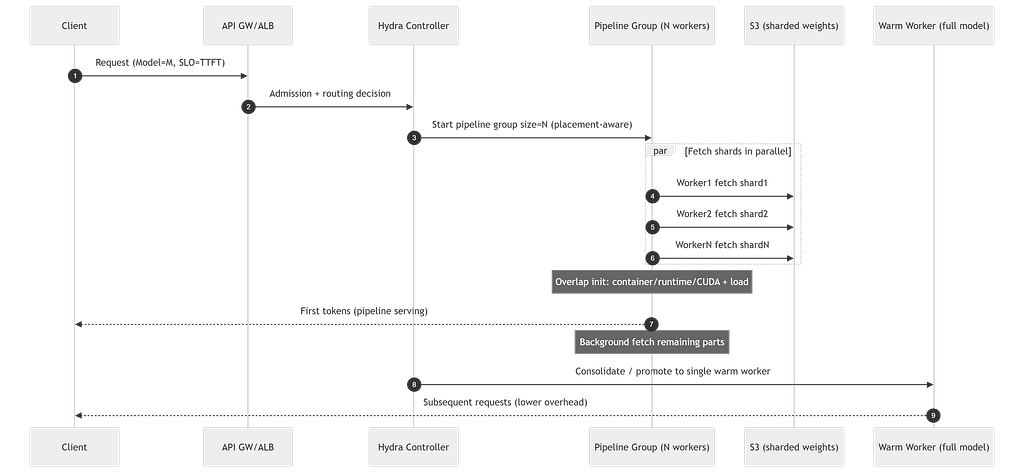
HydraServe leverages pipeline parallelism: instead of waiting for the entire model to fetch before doing anything, it distributes model parts across multiple GPU servers. Each part is fetched concurrently, meaning total fetch time drops because many servers share the work.
This contrasts with naive serverless setups that pull the whole model into a single worker before proceeding.
🧱 Three Levels of Optimization
HydraServe structures its optimization in a hierarchical design:
1. Cluster Level
- It determines how to distribute workers across physical nodes to avoid network contention
- Allocates resources based on user Service Level Objectives (SLOs)
- Determines how much parallelism to use based on model size and performance goals
By smartly placing workers across machines, it avoids bottlenecks where multiple instances fight for the same network bandwidth at once.
2. Worker Level
Traditional cloud instances treat model fetching, container creation, and library loading as sequential steps. HydraServe overlaps them instead:
- Model fetching begins immediately
- Container setup and CUDA context initialization run in parallel
- The parameter manager concurrently loads parameters into GPU memory
This parallel execution of otherwise sequential stages reduces wasted time.
3. Inference Level — Pipeline Consolidation
After a cold start begins with pipeline parallel groups (multiple workers each hosting a part of the model), HydraServe supports pipeline consolidation.
This means:
- Workers that started with partial models continue loading the rest in the background
- They gradually become standalone workers with complete models
- The system intelligently chooses whether to keep multiple pipeline workers or consolidate into fewer fully-loaded workers
This ensures peak performance for later requests while still gaining the cold start speedup from parallel initial loading.
The Measured Gains
HydraServe was evaluated under a range of realistic workloads, particularly those with bursty traffic that typifies serverless environments. Its improvements are impressive:
🔹 Cold start latency reduced by up to 4.7×
🔹 SLO attainment improved by up to 1.74×
These metrics show that HydraServe doesn’t just look good in theory — it meaningfully improves responsiveness and reliability for serverless LLM inference compared to traditional serverless approaches.
Why This Matters in Practice
This research highlights a broader truth about serverless AI:
- LLM cold start latency can no longer be ignored in production.
- Simply throwing more bandwidth or bigger machines at the problem isn’t enough.
- Intelligent orchestration at the cluster and worker level is necessary.
HydraServe’s approach — combining cluster-aware worker placement with overlapped initialization and pipeline parallelism — is a practical blueprint for public cloud providers and platform teams.
If you’ve ever felt the frustration of slow first tokens while everything else felt fast, this approach gives you a framework for tackling that problem head-on.
What You Could Build with These Ideas
Imagine deploying LLM inference on AWS and wanting:
- Instant responsiveness during traffic spikes
- No cold start delays longer than a second
- Dynamic scale-to-zero pricing benefits
- SLOs defined in terms of time-to-first-token (TTFT)
HydraServe’s lessons point toward:
- Distributing model parts across multiple GPU instances
- Parallelizing initialization stages
- Intelligent placement of workers to avoid shared bottlenecks
- Evolving partial workers into fully loaded ones
These ideas translate effectively into a cloud stack using orchestration layers like:
- Kubernetes / EKS for flexible multi-GPU worker placement
- Custom schedulers or operators to enforce network-aware placement
- Shared object stores / local caches for rapid model fetches
- Event triggers for on-demand scaling
Conclusion
HydraServe demonstrates that solving cold start latency for serverless LLM serving isn’t about tuning a single parameter or hardware bump. It’s about rethinking how a cloud platform organizes work across clusters, workers, and inference pipelines.
It’s a comprehensive, system-level solution that offers speed, elasticity, and cost-efficiency — the trifecta that serverless architects have been chasing for years.
If you’re building large-scale AI infrastructures that need both rapid scale-to-zero and rapid warm-up, HydraServe is an important design reference.