In this article, I would like to walk through the architecture design of enterprise version on how to train a large language model such as GPT or Claude.
Let us first discuss the functional requirements and non-functional requirements of this design.
Functional Requirements —
- The system must ingest data from diverse sources such as web book, research papers and code repositories
- It must extract and clean content from multiple formats
- It should be able to deduplicate and filter content based on quality and safety.
- It must implement model and data parallelism for large scale training.
- It must support multi-phase training, pre-training, fine-tuning, alignment and it must integrate with model monitoring platform.
Non-Functional Requirements —
- The system must scale to process petabytes of data and train models with 100 billion plus parameters
- Handle linearly increasing data set sizes and model complexity.
- It must efficiently distribute load across all available resources
Target Architecture —
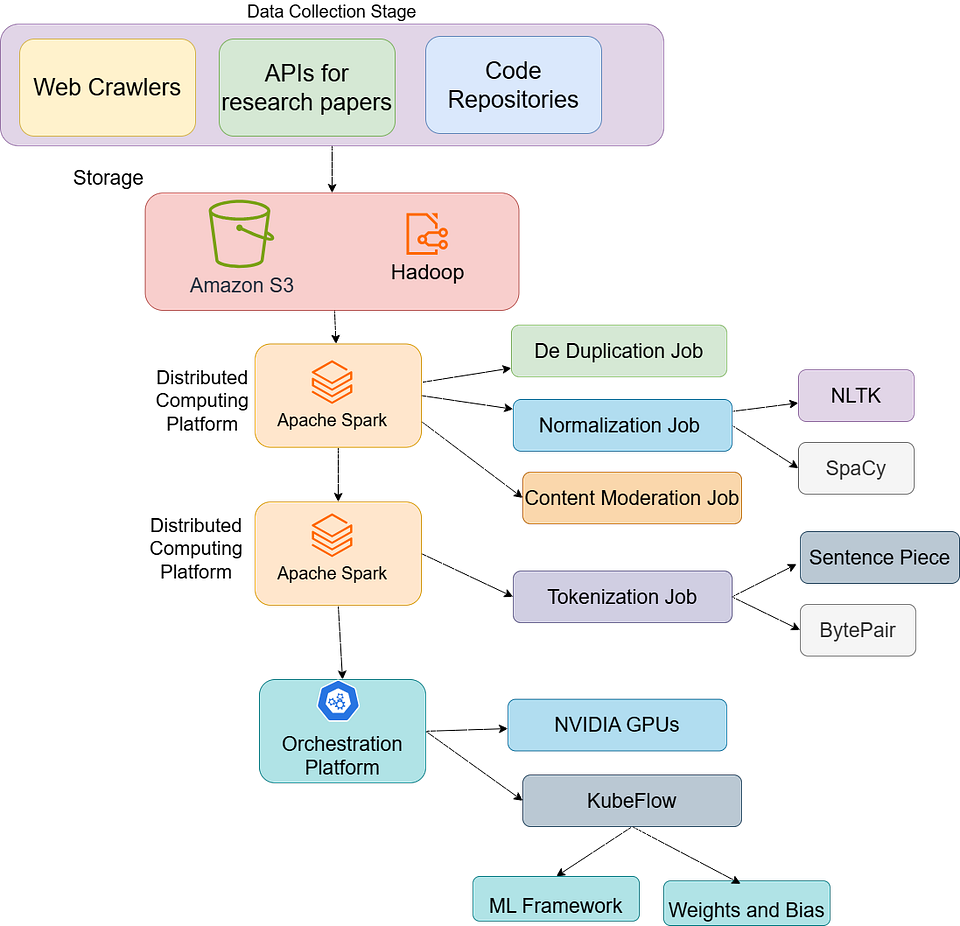
The architecture consists of five core layers that work sequentially to transform raw data into a sophisticated language model. Starting at the top and working our way down, the first layer is data collection.
Data Collection Layer
The foundational layer collects billions of text examples from diverse sources including web crawls, books, academic publications, and code repositories. The diversity and scale of this collection directly influences the model’s knowledge and understanding.
Here we can leverage the web crawlers like common crawl that will be used to collect peta bytes of public web content. While more targeted tools such as Scrapey will be used to extract data from specific websites. We will also use specialized APIs to enable access to scientific papers such as archive, medical research such as PubMed, and programming code such as GitHub.
To host our web crawlers and data collection jobs, we could use container app jobs on Azure or EC2 Instances on AWS. Effectively, you just need long running, low, computationally expensive resources for these tasks. If we have massive volume of raw data and these billions of data points require a robust storage solution. For this, we can leverage Amazon S# buckets or Azure blob storage with distributed storage system such as MinIO or Hadoop Distributed File System(HDFS). HDFS is a good solution as it will serve as a comprehensive data lake where all collected information is organized and managed before moving to the processing stage.
Data Processing Layer
This critical layer transforms raw collected data into high quality training material through rigorous cleaning, deduplication, quality assessment and content filtering as well as format standardization. These processes significantly impact model performance by ensuring the training data is representative, balanced and free from problematic content.
For this, we need to first determine a framework to handle the massive amount of data that was collected by our web crawlers and APIs. We can implement distributed computing frameworks like Apache Spark to handle processing at a massive scale. Apache is a general purpose distributed computing engine designed for large data. This will act as the overarching framework for all ETL steps such as transformation and normalization.
To ensure the data quality we will implement a deduplication job. It will scan our database identify duplications and remove them. This could be done by leveraging simple ML models or measurements such as cosine similarity. Following this, we will normalize the data. Our data is by nature textual. So we will utilize the natural language processing libraries like Spacey and NLTK to perform linguistic analysis, text cleaning and structural normalization.
Finally, we will also use hard filer on toxic or harmful content so it does not influence the model. To do this we will implement a simple ML model, content moderation logic such as banned word lists and cosine similarity to find the identical likely harmful text.
Tokenization Layer
This layer converts processed text into machine readable numerical sequences through vocabulary development, text segmentation and consistent token mapping. The tokenization strategy fundamentally shapes how the model interprets and generates language.
For this, we can implement all transformations using Apache Spark. To handle sheer scale of data we have collected we have want to change the architecture for this step. We can use serverless approach using AWS lambda or Azure functions. Standardization is best so we will use Apache Spark.
At the core of tokenization we have advanced algorithms like sentence piece and byte pair encoding (Convert words and sentences into machine readable values) which we will implement using tokenization job. These will intelligently break down text into subword units that balance vocabulary size with linguistic meaning, enabling models to handle rare words and morphological variations effectively. In simple terms, it is being able to condense and simplify language without losing or degrading the meaning. The job of tokenization cannot be underestimated. It is computationally expensive task that requires its own resources and you may find depending on the data set, it takes longer than training your model.
Computational Layer
This provides the massive distributed hardware resources, including specialized GPU clusters with high-speed interconnects necessary to handle the unprecedented scale of neural network training. Both model and data parallelism techniques are employed to optimize resource utilization.
We can either use anthropic or Open AI and we need to manage our own resources. We cannot simply purchase an offthe-shelf cloud surface. So we need to manage our own GPUs and our own resources.
We can separate the model training infrastructure from the model training process itself as it proves to be a distinct task or unit of work in itself, primarily focused on resource allocation.
Kubernetes will function as the backbone orchestration platform for managing containerized training workloads across large cluster of machines. Kubernetes automates deployment, scaling and management of training jobs, ensuring efficient resource utilization by scheduling containers onto appropriate hardware based on the requirements for LLM training. Kubernetes allows organizations to manage hundreds or thousands of GPU nodes as a single logic computing resource. NVIDIA GPUs serve as the primary computational workhorse for model training with each providing massive parallel processing capabilities. Large-scale LLM training typically employs clusters ranging from dozens to thousands of these GPUs working in parallel. These GPUs would then coordinate and communicate over infinitiband networking, a computer networking communication standard used in high performance computing.
Finally, we can use KubeFlow to support distributed training of our LLM. KubeFlow provides an end to end platform for orchestrating machine learning workflows on Kubernetes which is we are using. This will enable us to easily leverage Kubernetes and our horizontally distributed GPU environment. Finally, the training process itself.
Algorithmic Layer
This is the machine learning model or the algorithms layer that actually conducts the learning and produces a model.
There are additional layers which deploy and serve the model to end users. But these are equally as complex as the training layer. We are using Kubeflow to train our model. We can use either PyTorch or TensorFlow whichever is comfortable with primary framework for our model. The one chosen will implement the core algorithms for pre-training, fine-tuning and alignment. They both provide the mathematical foundation for operations like attention mechanisms, gradient descent and optimization techniques required across all training phases.
During pre-training, these frameworks efficiently process billions of tokens to build general language understanding. While in fine-tuning and alignment stages, they enable specific optimization objectives and specialized loss functions. And finally, we need an integrated service for model visibility. So we will use weights and biases. This platform provides comprehensive monitoring and visualization capabilities essential for LLM training runs that can last weeks or months. It captures metrics, hyperparameters, model graphs and training artifacts in a centralized dashboard, allowing us to make datadriven decisions.
For Large Language models where small performance improvements can represent significant resource savings, the ability to meticulously track training processes and compare variations becomes critical for efficient deployment.
We can also extend this framework by using the Hadoop cluster in step one as centralized storage or have a unique cluster for each step.